
- Home
- /
- Tools
- /
- Aligning Ads with Operations: How Inventory & Margin Data Improved Advertising Efficiency
Aligning Ads with Operations: How Inventory & Margin Data Improved Advertising Efficiency
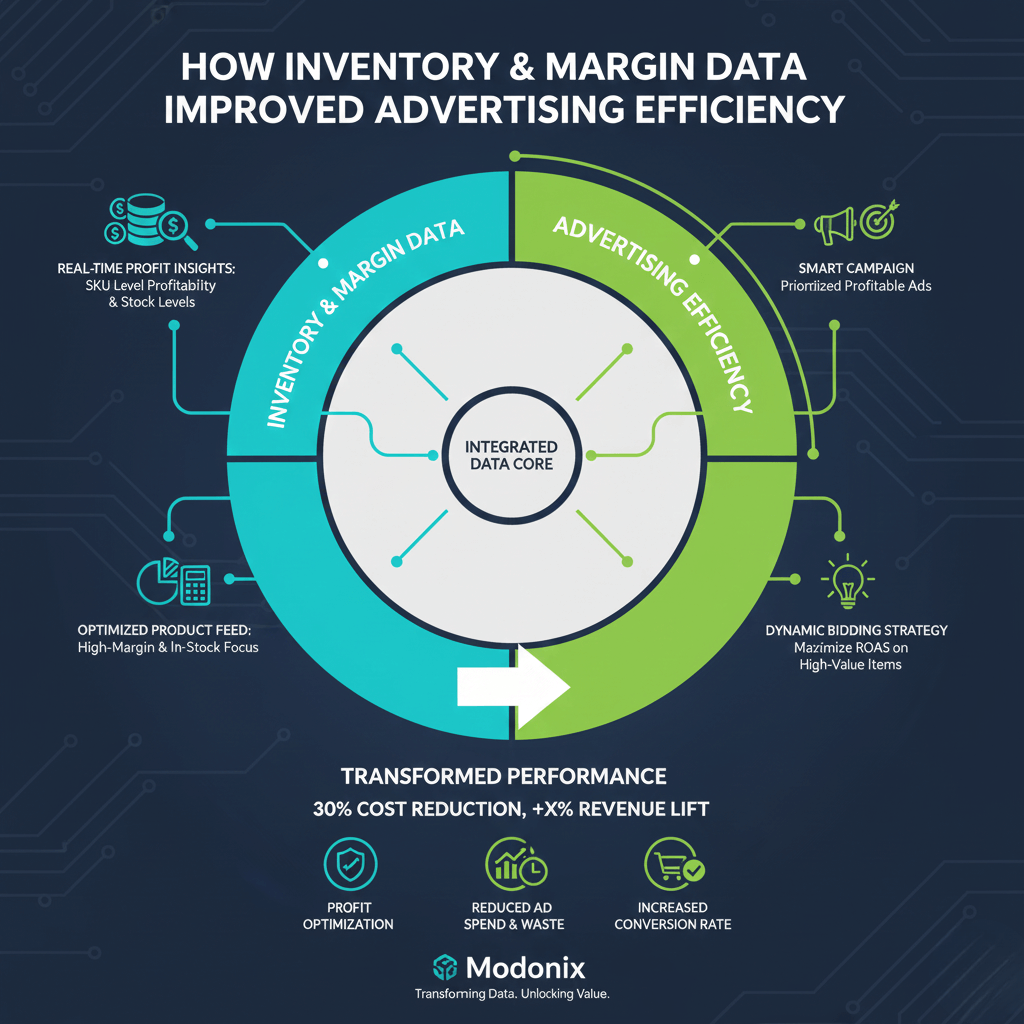
Modonix partnered with a U.S.-based e-commerce brand whose ads were performing well on the surface but operational blind spots were silently destroying profitability. By integrating real-time inventory visibility and margin data directly into campaign strategy, we rebuilt their acquisition workflow end-to-end reducing wasted ad spend, improving SKU prioritization, and increasing profit efficiency by 12–18% in the first 45 days.

Overview
A growing e-commerce brand approached Modonix with a familiar challenge: their products were strong, demand was healthy, and ROAS appeared stable, but profitability told a different story.
Campaigns were sending traffic to low-margin SKUs, ads were promoting out-of-stock variants, and the marketing team had no visibility into landed cost, contribution margin, or inventory constraints.
The brand wasn’t suffering from a lack of traffic.
They were suffering from operational misalignment.
They needed a unified system that connected:
- advertising
- inventory
- margin data
- SKU-level profitability
- operational constraints
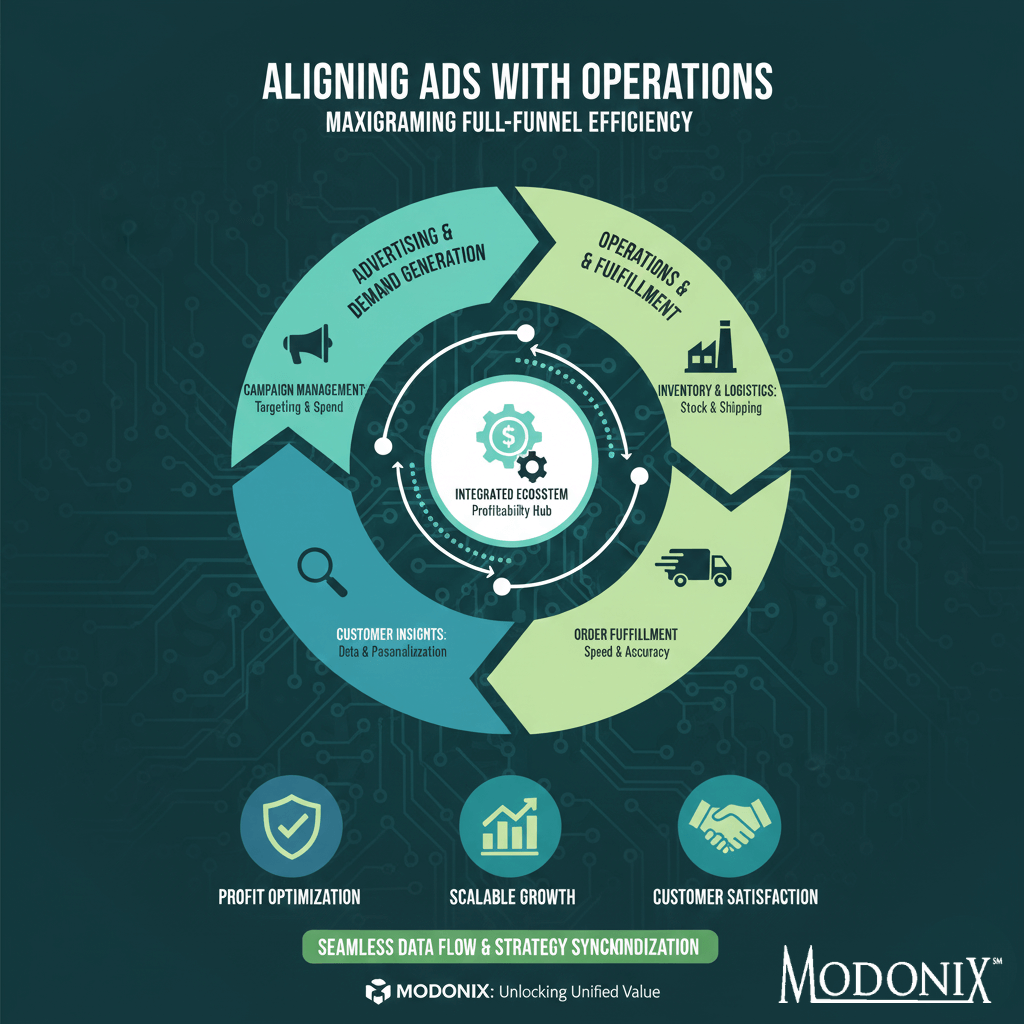
Modonix applied a system-first approach built on our Three Pillars: Performance, Insight, and Systems. Instead of optimizing campaigns in isolation, we rebuilt the acquisition engine around operational realities turning inventory and margin data into strategic inputs that guided spend, targeting, and SKU prioritization.
The goal was simple:
Shift from traffic-heavy ad operations to profit-aligned, inventory-aware advertising that scales sustainably.
Challenges
This brand had consistent traffic and steady revenue, yet operational gaps caused significant profit leakage. Their advertising engine was disconnected from operations, leading to:
- Ads promoting SKUs with low or negative margin
- Spend allocated toward products with limited or unstable stock
- Campaigns pushing variants that were weeks away from replenishment
- ROAS rewarded at the expense of contribution margin
- High-margin SKUs lacking visibility because they had higher CPAs
- No real-time inventory feed informing ad prioritization
- Leadership unable to forecast profitable campaign scaling
Despite strong demand, the brand’s acquisition system pushed the wrong products at the wrong times creating inefficiencies, revenue waste, and inconsistent customer experience.
Strategy Overview
Modonix implemented an operations-integrated advertising framework designed to unify inventory, margin data, and SKU-level profitability with campaign strategy.
Instead of optimizing based on ROAS, we rebuilt the model around:
- contribution margin
- inventory velocity
- restock cycles
- product profitability tiers
- operational constraints
- demand forecasting
Every campaign decision budgets, scaling, SKU prioritization was tied to operational data, not just ad metrics.
We synced the brand’s margin sheets, landed cost data, and inventory feeds to create a single real-time decision system for marketing.
Campaigns were realigned to prioritize high-margin, in-stock SKUs that delivered predictable contribution.
Spend was scaled or throttled based on stock levels, replenishment windows, and operational constraints.
SKU MAPPING
Mapped SKUs for strategic pricing insights.
PRICING SOP
Developed a structured pricing Standard Operating Procedure.
FEE ALIGNMENT
Aligned fees with margins to enhance profitability.
IMPLEMENTATION CADENCE
Established a regular cadence for pricing reviews.
Execution
Execution focused on aligning the advertising engine with operational reality not cosmetic creative changes or surface-level optimization.
Margin-Integrated SKU Mapping
• Contribution margin
• Net profitability
• Restock cycles
• Customer retention potential
• Shipping cost impact
This allowed the brand to know exactly which SKUs deserved paid promotion and which should never receive traffic.
Inventory-Aware Campaign Structuring
• High-margin, stable-stock SKUs (priority spend)
• Medium-margin SKUs (controlled testing)
• Low-margin SKUs (restricted or paused)
• OOS or unstable-stock items (no paid traffic)
Paid spend finally aligned with operational constraints.
Real-Time Stock Alerts
• Inventory was running low
• SKUs approached depletion
• Replenishment was delayed
• High-velocity items needed campaign throttling
This eliminated wasted spend and prevented customer disappointment.
Profit-Driven Budget Allocation
Cross-Team Alignment
• The same margin data
• The same inventory feed
• The same SKU priority list
• The same profitability model
This removed friction and established a unified decision-making system.
Results
Within 75–90 days, the brand achieved measurable improvements in efficiency, profitability, and operational alignment driven strictly by better data, not additional traffic.
Advertising efficiency isn’t created in the ad platform it’s created in operations.
When inventory, margin, and SKU profitability guide campaign strategy, brands stop wasting money and start scaling sustainably.
Ready to Grow with Modonix?
Let’s turn your digital goals into measurable results. Whether you’re scaling an eCommerce brand or refining your online strategy, Modonix is here to help.

Leverage our methodology for success. Measure your performance; Identify improvements using proven strategies; Implement; then Thrive.

Quick Links
Services
© 2026 Modonix LLC. All Rights Reserved. | Privacy Policy
Melbourne, FL