
- Home
- /
- Tools
- /
- Beyond ROAS: How a Profit-First Analytics Framework Stabilized Paid Campaign Performance
Beyond ROAS: How a Profit-First Analytics Framework Stabilized Paid Campaign Performance
Modonix partnered with a U.S.-based e-commerce brand struggling with unstable paid campaign performance and unpredictable profitability. By replacing their ROAS-only reporting model with a profit-first analytics framework, we rebuilt their entire decision system strengthening campaign consistency, stabilizing margins, and improving high-intent conversion efficiency within the first 60 days.

Overview
A growth-focused e-commerce brand approached Modonix with a familiar challenge: their paid campaigns generated revenue, but profitability was volatile and unpredictable. ROAS fluctuated daily, cost per conversion was unstable, and their reporting system lacked visibility into margin performance.
Marketing was operating with incomplete data. The team optimized for ROAS, not profit, and leadership had no clear understanding of whether campaigns were actually generating cash.
They needed a modernized analytics framework one that connected ad spending to contribution margin, stabilized performance, and created a consistent method for evaluating campaign decisions.
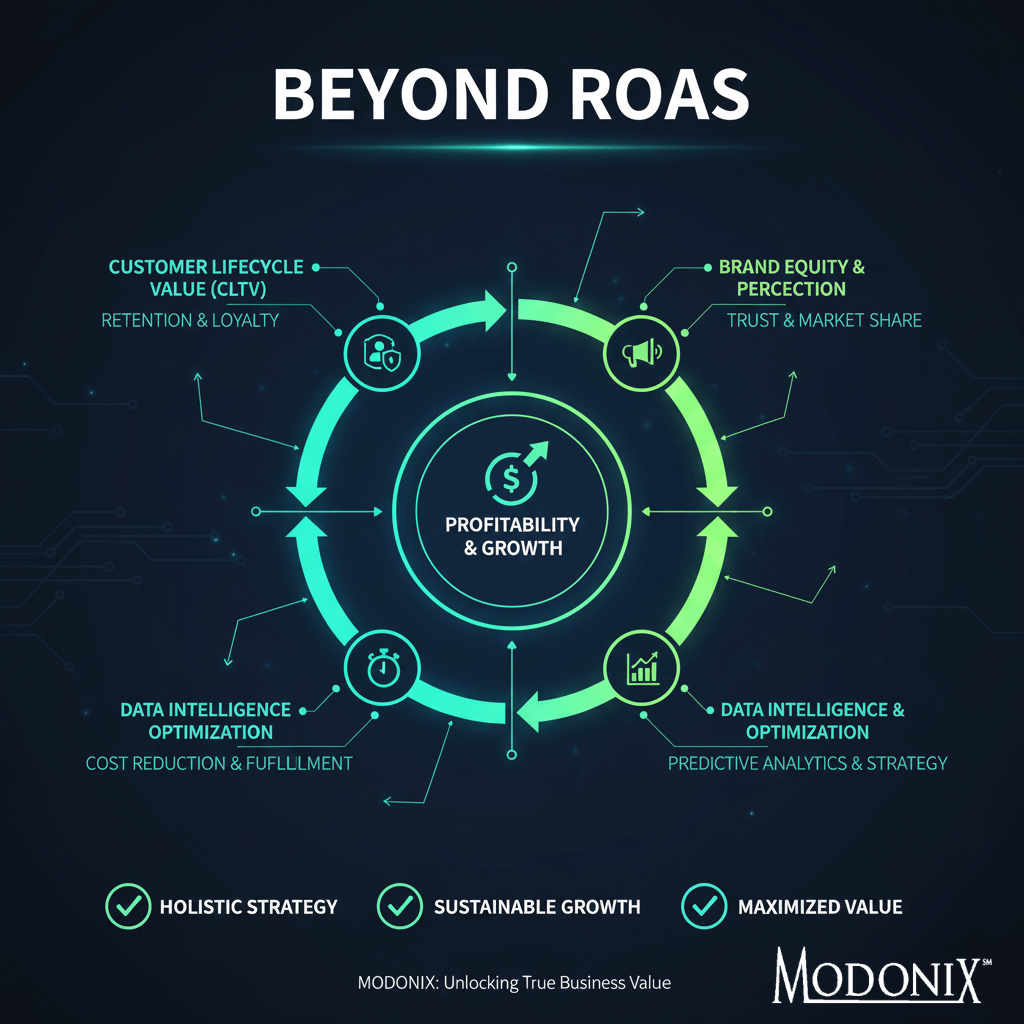
Modonix applied a system-first approach built on our Three Pillars: Performance, Insight, and Systems. Instead of chasing cheaper clicks or optimizing isolated campaigns, we rebuilt the attribution and reporting structure from the ground up integrating margin data, creating contribution-based metrics, and transforming ROAS into a secondary, not primary, KPI.
The goal was simple:
Turn a fluctuating, ROAS-driven account into a stable, profit-driven engine without increasing budget.
Challenges
The brand had been running paid ads for years, yet their analytics never reflected the actual financial health of the campaigns. Their data system was scattered across platforms, leading to:
- ROAS-first decision making with no visibility into true profit
- Inability to see contribution margin at the campaign or product level
- Large swings in daily ROAS caused by attribution noise
- Marketing decisions disconnected from COGS, shipping, and fees
- Over-investment in unprofitable SKUs simply because they “converted”
- Under-investment in high-margin SKUs due to lower ROAS signals
- No unified metric to align the marketing and finance teams
Despite steady revenue, the account behaved like a roller coaster strong week followed by severe dips because decisions were based on surface-level KPIs, not real financial insight.
Strategy Overview
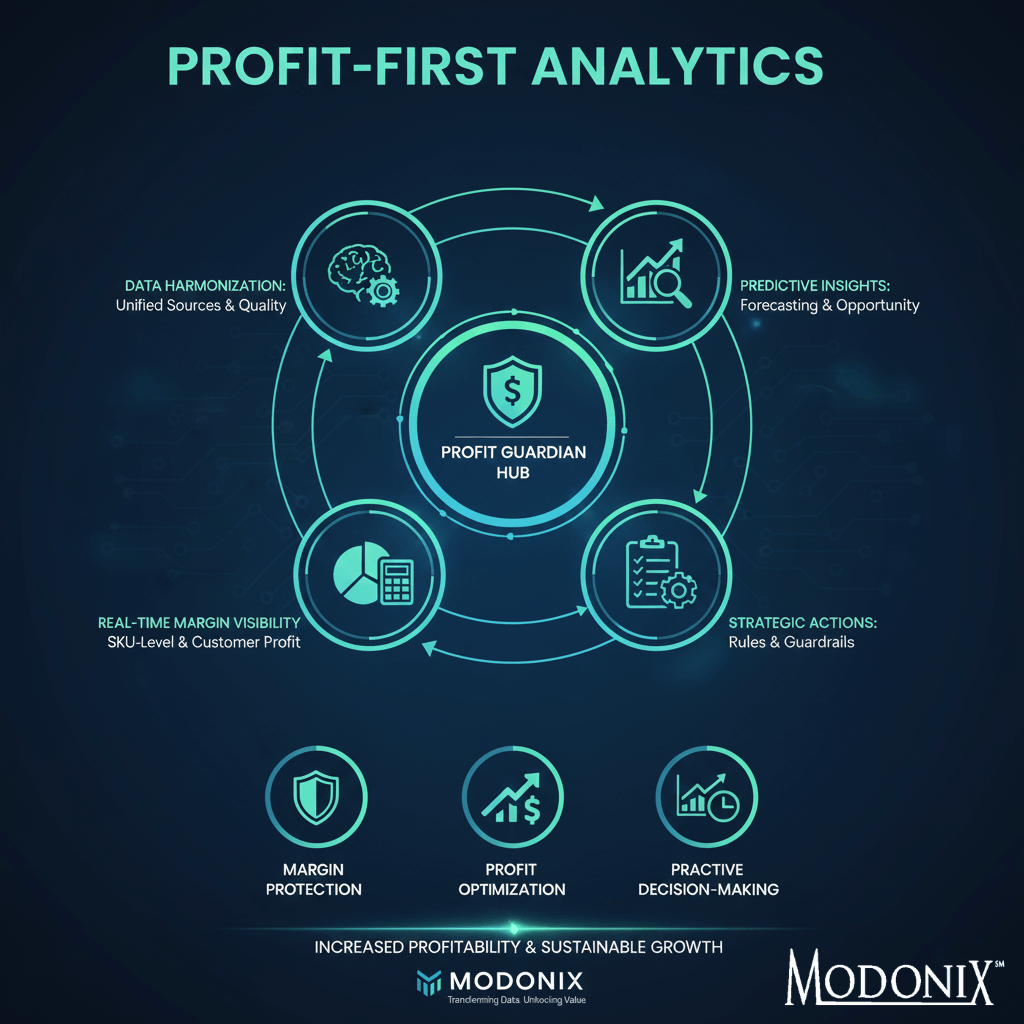
Modonix implemented a full margin-integrated analytics framework designed to stabilize performance, improve financial visibility, and build discipline into campaign decision-making.
Instead of optimizing for ROAS, the new model prioritized:
- contribution margin
- breakeven ad cost
- cost-per-profit unit
- MER-aligned spend allocation
- SKU profitability thresholds
Every optimization decision from scaling budgets to pausing campaigns was tied to contribution margin, not platform reported ROAS.
By integrating product cost data, shipping fees, and merchant expenses, we built a complete picture of real profitability across channels.
Instead of daily ROAS swings dictating spend, a margin-based guardrail system created a predictable, controlled scaling environment.
Campaign reporting shifted from vanity KPIs to a clean set of profit-aligned metrics giving leadership the visibility required for confident decisions.
SKU MAPPING
Mapped SKUs for strategic pricing insights.
PRICING SOP
Developed a structured pricing Standard Operating Procedure.
FEE ALIGNMENT
Aligned fees with margins to enhance profitability.
IMPLEMENTATION CADENCE
Established a regular cadence for pricing reviews.
Execution
Execution focused on financial clarity, not cosmetic reporting dashboards. The objective was to build a disciplined, scalable profit-driven analytics engine that stabilized performance and reduced volatility.
Margin-Integrated Campaign Model
• Contribution margin per order
• Breakeven ROAS
• Breakeven CPA
• MER impact per SKU
• SKU-level profitability tied to spend
• Cost-adjusted profitability trends
This model became the operating core of all budget decisions.
Profit-First Reporting Layer
• Cost-per-profit dollar
• Profit contribution by campaign
• SKU-level margin impact
• Spend efficiency scoring
• Profitability thresholds for scaling
This eliminated guesswork and attribution noise.
Campaign Restructuring
• Grouped high-margin SKUs into scalable clusters
• Separated low-margin SKUs to prevent profit dilution
• Implemented structured testing aligned with contribution margin
• Stabilized budgets with guardrails based on breakeven thresholds
Guardrail System
• Spend exceeding MER limits
• Campaigns generating negative contribution
• SKU groups with margin erosion
• Scaling opportunities based on profit velocity
Marketing decisions became predictable, disciplined, and controllable.
Results
Within 60 days, performance stabilized, margins increased, and the brand finally understood where profit was coming from—and where it was disappearing.
Optimizing for ROAS grows revenue.
Optimizing for profit grows businesses.
A profit-first analytics framework transforms paid campaigns from volatile, unpredictable systems into stable, disciplined engines that support sustainable long-term growth.
Ready to Grow with Modonix?
Let’s turn your digital goals into measurable results. Whether you’re scaling an eCommerce brand or refining your online strategy, Modonix is here to help.

Leverage our methodology for success. Measure your performance; Identify improvements using proven strategies; Implement; then Thrive.

Quick Links
Services
© 2026 Modonix LLC. All Rights Reserved. | Privacy Policy
Melbourne, FL