Case Study

Aligning Ads with Operations: How Inventory & Margin Data Improved Advertising Efficiency

Modonix partnered with a U.S.-based e-commerce brand whose ads were performing well on the surface but operational blind spots were silently destroying profitability. By integrating real-time inventory visibility and margin data directly into campaign strategy, we rebuilt their acquisition workflow end-to-end reducing wasted ad spend, improving SKU prioritization, and increasing profit efficiency by 12–18% in the first 45 days.

Aligning Ads With Operations-1

Overview

A growing e-commerce brand approached Modonix with a familiar challenge: their products were strong, demand was healthy, and ROAS appeared stable, but profitability told a different story.

Campaigns were sending traffic to low-margin SKUs, ads were promoting out-of-stock variants, and the marketing team had no visibility into landed cost, contribution margin, or inventory constraints.

The brand wasn’t suffering from a lack of traffic.
They were suffering from operational misalignment.

They needed a unified system that connected:

  • advertising
  • inventory
  • margin data
  • SKU-level profitability
  • operational constraints

Modonix applied a system-first approach built on our Three Pillars: Performance, Insight, and Systems. Instead of optimizing campaigns in isolation, we rebuilt the acquisition engine around operational realities turning inventory and margin data into strategic inputs that guided spend, targeting, and SKU prioritization.

The goal was simple:
Shift from traffic-heavy ad operations to profit-aligned, inventory-aware advertising that scales sustainably.

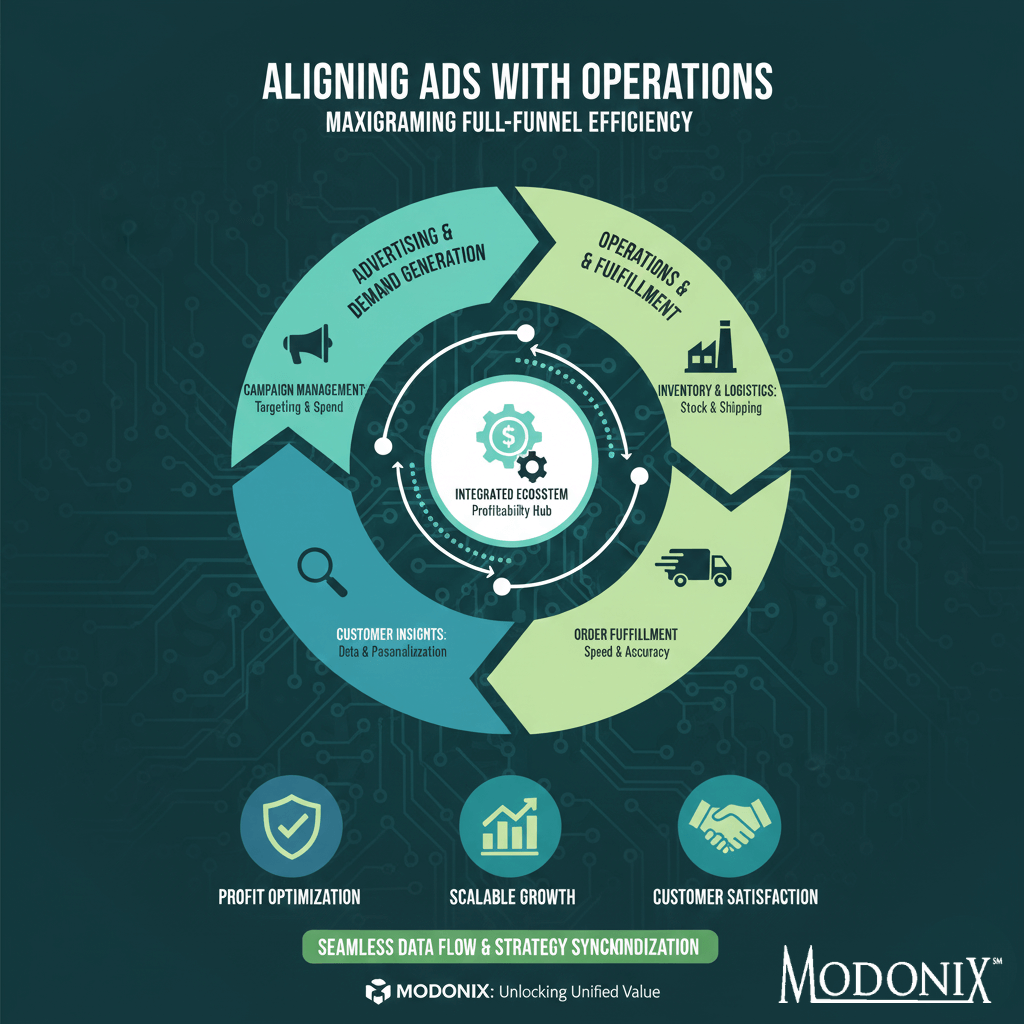
Aligning Ads with Operations

Challenges

This brand had consistent traffic and steady revenue, yet operational gaps caused significant profit leakage. Their advertising engine was disconnected from operations, leading to:

  • Ads promoting SKUs with low or negative margin
  • Spend allocated toward products with limited or unstable stock
  • Campaigns pushing variants that were weeks away from replenishment
  • ROAS rewarded at the expense of contribution margin
  • High-margin SKUs lacking visibility because they had higher CPAs
  • No real-time inventory feed informing ad prioritization
  • Leadership unable to forecast profitable campaign scaling

Despite strong demand, the brand’s acquisition system pushed the wrong products at the wrong times creating inefficiencies, revenue waste, and inconsistent customer experience.

Opportunity

During the audit, Modonix uncovered several high-impact opportunities to synchronize operations with advertising:

  • Ads were driving volume to SKUs with poor margin structure.
  • Inventory levels were not factored into budget allocation.
  • Marketing had no visibility into landed cost, COGS shifts, or freight impact.
  • SKU prioritization was based on ROAS rather than profitability.
  • OOS (out-of-stock) variants were still receiving paid traffic.
  • High margin, high-retention products lacked dedicated campaigns.

The real opportunity wasn’t more traffic it was better alignment between operations and marketing systems.

With clean margin data and real-time inventory feeds, the brand could stop wasting spend and begin prioritizing SKUs that strengthened profitability.

Strategy Overview

Modonix implemented an operations-integrated advertising framework designed to unify inventory, margin data, and SKU-level profitability with campaign strategy.

Instead of optimizing based on ROAS, we rebuilt the model around:

  • contribution margin
  • inventory velocity
  • restock cycles
  • product profitability tiers
  • operational constraints
  • demand forecasting

#key_pillar_point_heading_

#key_pillar_point_content

Execution

Execution focused on aligning the advertising engine with operational reality not cosmetic creative changes or surface-level optimization.

Margin-Integrated SKU Mapping

We categorized the entire catalog by:
• Contribution margin
• Net profitability
• Restock cycles
• Customer retention potential
• Shipping cost impact
This allowed the brand to know exactly which SKUs deserved paid promotion and which should never receive traffic.

Inventory-Aware Campaign Structuring

Campaigns were reorganized into tiers:
• High-margin, stable-stock SKUs (priority spend)
• Medium-margin SKUs (controlled testing)
• Low-margin SKUs (restricted or paused)
• OOS or unstable-stock items (no paid traffic)
Paid spend finally aligned with operational constraints.

Real-Time Stock Alerts

We built automated signals that notified the marketing team when:
• Inventory was running low
• SKUs approached depletion
• Replenishment was delayed
• High-velocity items needed campaign throttling
This eliminated wasted spend and prevented customer disappointment.

Profit-Driven Budget Allocation

Budgets were redistributed based on margin contribution, with scaling rules tied to profitability thresholds—not ROAS. This shifted spend toward the SKUs that actually grew the business.

Cross-Team Alignment

Marketing, operations, and finance now worked from:
• The same margin data
• The same inventory feed
• The same SKU priority list
• The same profitability model
This removed friction and established a unified decision-making system.
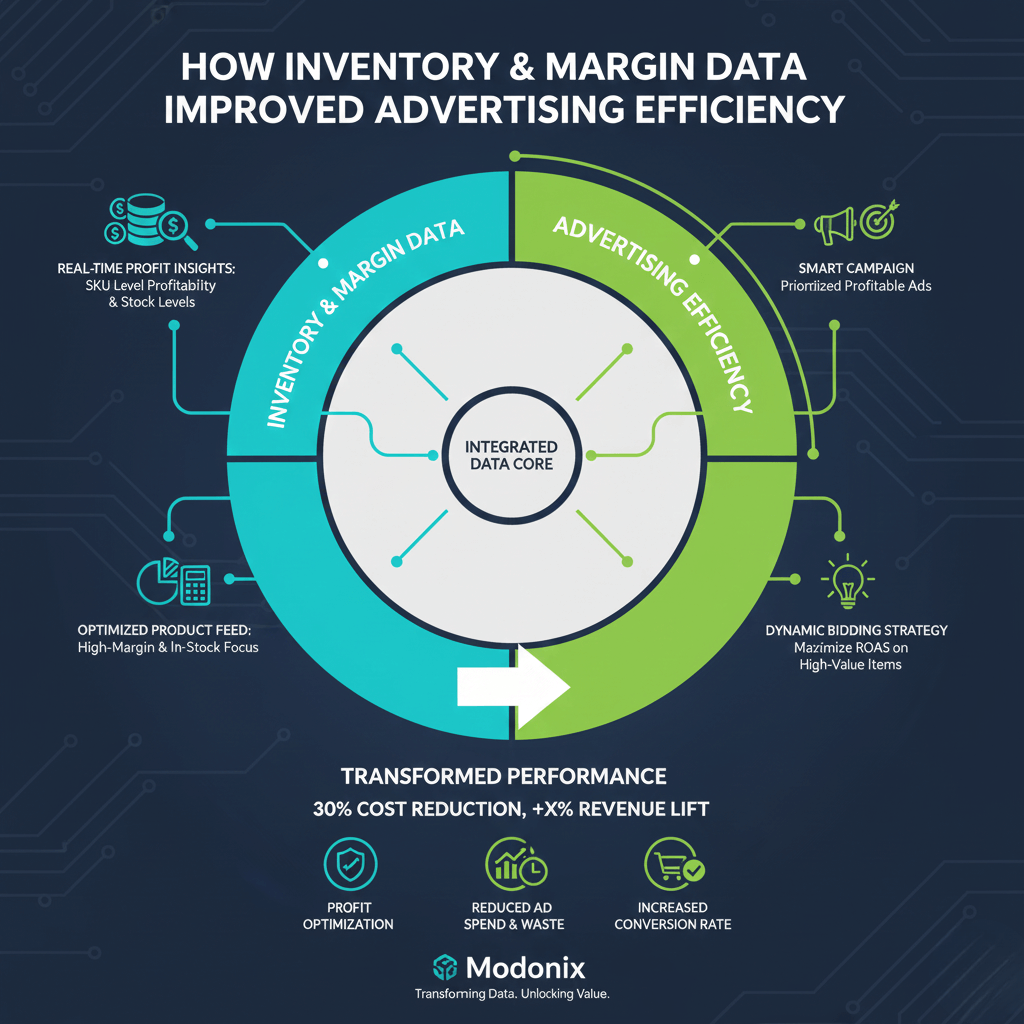
How Inventory & Margin Data Improved Advertising Efficiency

Results

Within 75–90 days, the brand achieved measurable improvements in efficiency, profitability, and operational alignment driven strictly by better data, not additional traffic.

#metric

#result

+ 0 %

Within 75–90 days, the brand achieved measurable improvements in efficiency, profitability, and operational alignment driven strictly by better data, not additional traffic.

Key Takeaway

Advertising efficiency isn’t created in the ad platform it’s created in operations.

When inventory, margin, and SKU profitability guide campaign strategy, brands stop wasting money and start scaling sustainably.

Ready to Grow with Modonix?

Let’s turn your digital goals into measurable results. Whether you’re scaling an eCommerce brand or refining your online strategy, Modonix is here to help. Book a consultation and take the first step toward smarter, faster growth.

Wait! Book a free growth audit – it only takes 30 seconds.