Case Study

Streamlining Cash Flow: How Better COGS Tracking Improved Forecasting Accuracy

Modonix partnered with a fast-growing U.S. e-commerce retailer struggling with inconsistent cash flow, inaccurate forecasting, and unclear cost structures across thousands of SKUs. By implementing a unified COGS tracking system, standardizing cost inputs, and rebuilding their financial visibility from the ground up, we enabled the business to plan more accurately, maintain healthier cash flow, and improve profitability within the first 90 days.

COGS Tracking

Overview

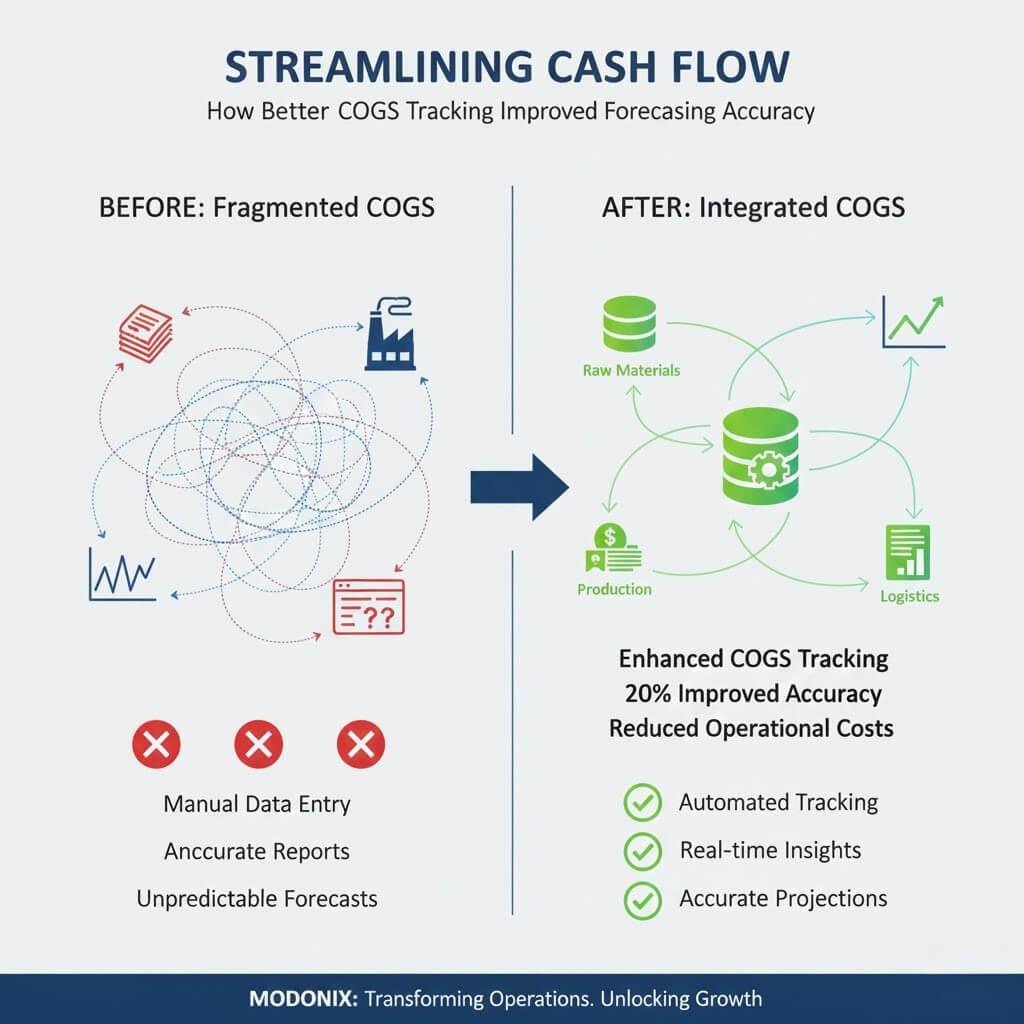
A U.S.-based retailer approached Modonix with a familiar operational challenge: their business was growing, but their numbers weren’t telling the truth. COGS varied wildly between suppliers, product families, and even different purchasing cycles. Shipping surcharges, hidden fees, and inconsistent vendor invoices made forecasting nearly impossible.

Their cash flow suffered because purchasing decisions were based on incomplete data. Some SKUs were over-ordered, others starved inventory for weeks, and high-margin items were buried under inaccurate costing. Without clear COGS visibility, financial planning became guesswork causing unpredictable margins and unnecessary strain on working capital.

They needed more than a spreadsheet cleanup. They needed a system that captures real COGS, tracks supplier changes, and feeds forecasting models with reliable data.

Modonix applied a system-first approach rooted in our Three Pillars: Performance, Insight, and Systems. Instead of simply calculating COGS SKU-by-SKU, we created a financial data foundation one that standardized costs, organized supplier fees, and improved forecasting accuracy across the entire catalog.

The goal was simple: build a clean, reliable cost structure that strengthens cash flow and supports confident decision-making.

Streamlining Cash Flow

Challenges

This retailer had strong sales volume but weak financial visibility. Their cost structure was scattered across multiple systems, leading to:

  • Inconsistent COGS across 10–12 suppliers
  • Hidden freight and surcharge fees not reflected in product costs
  • No SKU-level cost tracking, especially across thousands of items
  • Poor forecasting accuracy due to unreliable cost inputs
  • Over-ordering and under-ordering caused by margin miscalculations
  • Limited visibility into supplier price fluctuations
  • Unpredictable cash flow cycles caused by irregular purchasing habits
  • Outdated spreadsheets that weren’t synchronized with real activity

Despite healthy revenue, the business lacked financial clarity resulting in misallocated purchasing budgets and unstable cash flow.

Opportunity

During the operational audit, Modonix uncovered several critical opportunities to streamline financial operations and rebuild cost accuracy:

  • Establish a centralized COGS system to reflect real product costs
  • Standardize cost inputs across all 10–12 suppliers
  • Capture hidden fees (freight, surcharges, handling) inside each SKU
  • Build formulas that automatically update forecasting based on updated COGS
  • Partner with suppliers and carriers to reduce cost variability
  • Structure purchasing cycles to align with true profitability
  • Implement a COGS audit process for continuous accuracy
  • Integrate COGS tracking into inventory planning and forecasting models

The biggest opportunity was clear: accurate COGS is the foundation of accurate forecasting.
Once the business understood its real costs, financial planning improved instantly.

Strategy Overview

Modonix designed a system-first strategy focused on financial clarity, predictable cash flow, and accurate COGS tracking. Instead of short-term fixes, we built a repeatable financial process that improved forecasting and profitability across thousands of SKUs.

#key_pillar_point_heading_

#key_pillar_point_content

Execution

Execution focused on accuracy and structure, not redesigning tools or creating complex software. The goal was to build a financial system that the business could trust.

COGS Standardization

We consolidated cost data from 10–12 suppliers, normalized each cost component, and rebuilt the SKU-level structure for thousands of items.

Hidden Fee Integration

Freight, handling fees, surcharges, packaging, and inbound costs were incorporated directly into SKU-level COGS revealing true profitability.

Forecasting Reconstruction

We rebuild the financial forecast model using:
• Standardized COGS
• Velocity data
• Supplier lead times
• Cash flow timing

Supplier Alignment

We collaborated with suppliers to receive clearer invoices, predictable billing cycles, and more consistent fee structures.

Dashboard Implementation

A financial dashboard was introduced to track:
• COGS changes
• Margin stability
• Forecast accuracy
• SKU-level profitability
• Cost trends per supplier

Operational Documentation

We documented:
• COGS update rules
• Cost categorization
• Forecasting workflows
• Supplier communication SOPs
• Monthly and quarterly financial review cycles
This created a scalable financial management system.
Streamlining Cash Flow

Results

Within 60–90 days, the client saw measurable improvements in financial clarity, cash flow, and forecasting accuracy.

#metric

#result

+ 0 %

Within 60–90 days, the client saw measurable improvements in financial clarity, cash flow, and forecasting accuracy.

Key Takeaway

Improving cash flow doesn’t start with cutting costs, it starts with understanding them. When COGS becomes accurate and transparent, forecasting improves, purchasing becomes smarter, and profitability increases naturally. Financial clarity is the foundation of operational control.

Ready to Grow with Modonix?

Let’s turn your digital goals into measurable results. Whether you’re scaling an eCommerce brand or refining your online strategy, Modonix is here to help. Book a consultation and take the first step toward smarter, faster growth.

Wait! Book a free growth audit – it only takes 30 seconds.